Love
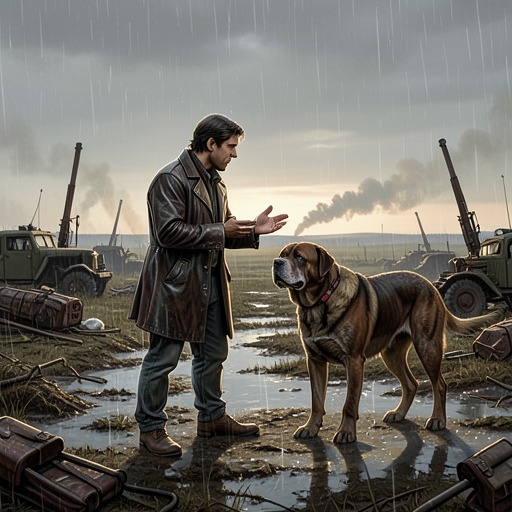
A Boy and His DogLove is the central moral and emotional problem of A Boy and His Dog. In a devastated postwar world, where survival reduces intimacy to food, sex, reproduction, and protection, the word is repeatedly used before its meaning is understood. Vic treats Blood as a companion, provider, and indispensable partner while also speaking of him with open hostility; Quilla June Holmes asks Vic to name an emotion he has never experienced; and the conclusion forces love into the form of a choice. The novella’s final assertion, “A boy loves his dog,” gives the bond between Vic and Blood a certainty that the human relationship cannot sustain, while leaving the nature of love deliberately troubling rather than sentimental.
Love as Survival and Exchange
At the beginning, Vic’s relation to love is inseparable from scarcity and bodily need. He is fifteen, scavenging the wastelands with Blood, and the two operate through a practical division of labor: Blood guides Vic toward women, while Vic makes sure Blood is fed. Their arrangement turns sexual access and food into reciprocal resources. After catching water rats and a lost manicured poodle for Blood, Vic demands that the dog find him “a piece of ass.” The request presents intimacy not as mutual recognition but as a service Blood is expected to procure in return for nourishment.
Blood’s telepathy makes the arrangement unusually intimate without making it ethically healthy. He can mock Vic’s sexual appetite, call him Albert, and answer his crude demands with amusement. The dog is not a mute possession or a simple survival tool: he communicates, remembers, interprets Vic’s behavior, and participates in the pair’s decisions. Yet the bond remains asymmetrical and abrasive. Vic supplies food and physical protection; Blood supplies knowledge, direction, and access to women. Love is therefore introduced as something embedded in dependency, exchange, and mutual usefulness rather than as an ideal standing outside material conditions.
The history of telepathic dogs deepens this contradiction. Blood descends from Ginger, a German shepherd used by the Los Angeles Police Department’s narcotics division, and Ahbhu, the first successful product of cetacean experimentation to communicate sense-impressions telepathically. Later breeding produced skirmisher dogs trained to track gasoline, troops, poison gas, and radiation for human controllers during the Third War. Blood’s intelligence is thus the product of human instrumentalization, but his relationship with Vic exceeds that military origin. The same animal lineage shaped for command and detection becomes the foundation of a personal partnership whose emotional force cannot be reduced to utility.
Quilla June Holmes and the Question of Love
Quilla June Holmes brings the word into direct examination. After drawing closer to Vic, she asks whether he has ever been in love with a girl. Vic answers that he has not, then insists that he knows what love is anyway. Her follow-up—“Do you know what love is?”—exposes the gap between his confidence and his experience. Vic can recognize desire, possession, protection, and loyalty, but he has no stable language for the distinction between them.
His first response to Quilla June’s fear reveals that something in him has begun to change, even before he can interpret it. During the assault, he notices that her terror makes him want to say something reassuring. He has never previously wanted to speak to a sexual partner in that way; ordinarily, he has sought immediate gratification without concern for the woman’s feelings. The impulse passes, and he continues to threaten and control her, so the scene does not become evidence of a completed moral transformation. It does, however, mark an involuntary disturbance in his habitual emotional pattern: Quilla June’s fear reaches him as something more than an obstacle.
Their attachment develops through the same coercive conditions that govern the rest of the book. Quilla June has lured Vic into the underground civilization, and the relationship is entangled with captivity, sexuality, social reproduction, and the authority of her family. Her affection is real within the evidence, but it is expressed through pressure as well as tenderness. She tells Vic that he has a responsibility to her and reminds him of the dangers from which he has been protected, including the burnpit-screamer that once attacked him. Love becomes a claim upon another person, and the claim is inseparable from memory, debt, fear, and the demand for continued allegiance.
Love Tested by Escape
The escape from the underground world converts the question into action. When Quilla June and Vic climb through the access route, she repeatedly asks whether he loves her whenever exhaustion makes her stop. Vic answers yes, both because he means it and because the answer helps her continue climbing. Love here functions simultaneously as confession, encouragement, and survival technology. It gives Quilla June the strength to move upward, while the dangerous ascent turns an abstract emotional question into a bodily test.
The relationship reaches its decisive crisis when Blood is wounded and Quilla June urges Vic to leave him behind. She tells Vic that Blood will be all right and insists that they must hurry; later she makes the condition explicit: if Vic loves her, he will come with her. Her appeal exposes a rivalry between two forms of attachment. Quilla June demands proof through abandonment, while Blood’s condition makes abandonment materially impossible for Vic. The choice is not presented as a calm comparison between romantic and animal love. It is made under pursuit, exhaustion, injury, and the knowledge that Vic cannot survive alone without Blood.
Vic chooses the dog. He carries Blood, shelters with him in an air duct, feeds him before eating himself, tends his wounds, and holds him through the night. Blood is still limping when they cross the blasted wasteland the next morning, so their progress is slow. These precise acts of care supply the novella’s strongest concrete definition of love: not verbal certainty, sexual desire, or a promise extracted under pressure, but continued responsibility toward a vulnerable companion when that responsibility costs time, food, safety, and freedom.
The Ending and Its Double Meaning
After leaving Quilla June Holmes, Vic continues to hear her calling in his head and repeating the question about love. The persistence of her voice prevents the ending from becoming a simple victory for Vic and Blood. His decision has consequences: he has chosen the established partnership, but he has also abandoned the girl who loved him and helped him escape. The emotional residue of the choice remains audible even after the physical separation.
Vic’s final formulation, “A boy loves his dog,” is emphatic but not uncomplicated. It confirms the depth of his bond with Blood, whose presence has defined Vic’s survival, identity, and movement through the ruined world. At the same time, the sentence answers Quilla June’s question by shifting its terms. Vic does not demonstrate that he understands love in the conventional romantic sense; instead, he identifies love with a durable, embodied loyalty that has existed before his encounter with her and survives it.
The book’s framing materials reinforce this ambiguity. The volume pairs the novella with Harlan Ellison’s account of Ahbhu, the real dog who inspired Blood. Ellison describes Ahbhu as “a person” while insisting that he was impossible to anthropomorphize. That tension parallels the fiction’s treatment of Blood: the dog is granted communication, agency, ancestry, and emotional importance without simply being turned into a human substitute. Love therefore crosses the human–animal boundary, but it does not erase the difference between species.
Narrative and Thematic Significance
Love organizes the novella’s major contrasts: appetite against care, possession against responsibility, romance against companionship, and human social order against the chosen bond between a boy and his dog. The underground civilization’s interest in reproduction and controlled social survival gives intimacy a public and biological function, while Vic and Blood’s partnership appears private, improvised, and fiercely personal. Yet neither relationship is wholly innocent. Blood’s guidance toward women is instrumental, Vic’s treatment of women is violent, and Quilla June’s appeals to love can become coercive.
For that reason, love in the novella is not a consoling force that repairs the postapocalyptic world. It is a pressure that reveals what the characters will protect, what they will demand, and what they are willing to sacrifice. Vic’s care for Blood is genuine, but it coexists with cruelty; his attachment to Quilla June is genuine, but it cannot displace his older loyalty. The final choice gives love a clear object without giving it a morally pure form. In the ruined world of A Boy and His Dog, love survives not as an abstract promise of human goodness, but as an exposed, contested practice of dependence and choice.